

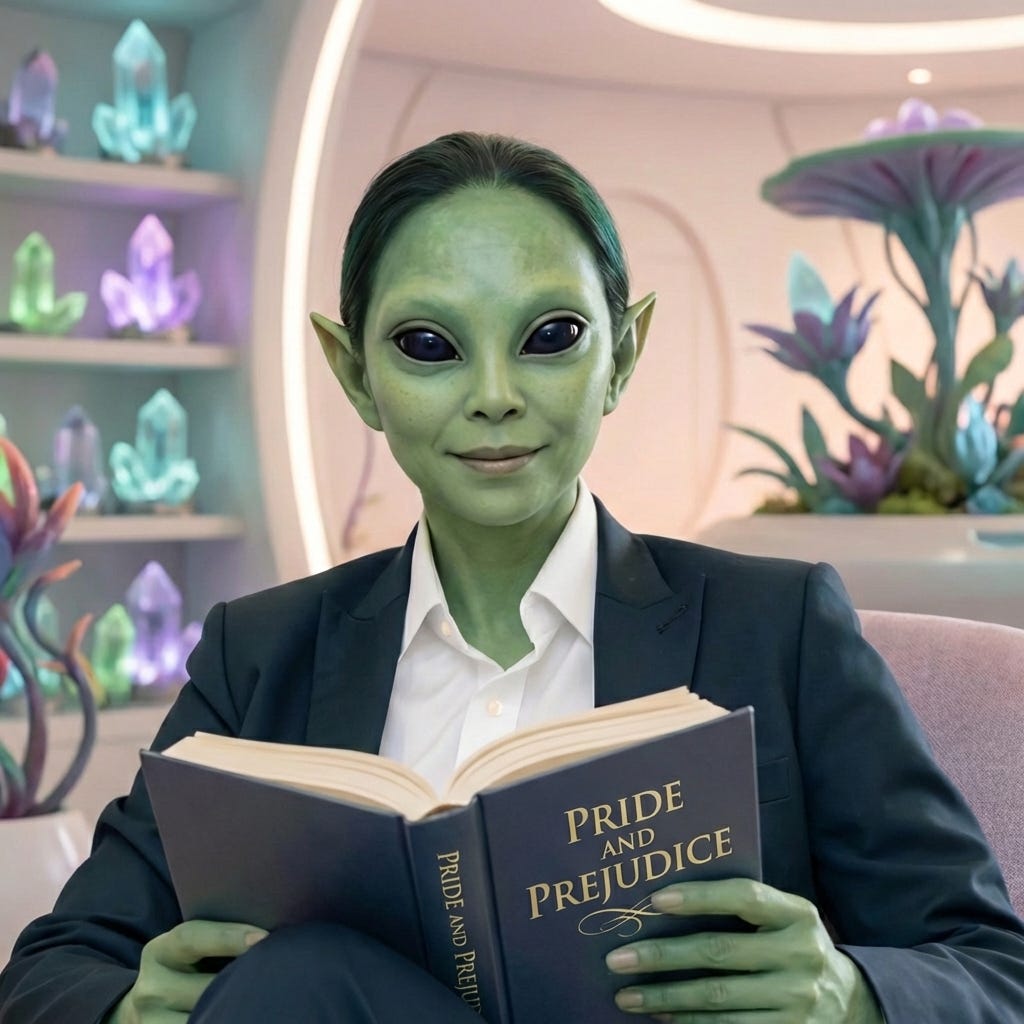
If I landed on Earth today, all wide‑eyed, antennae hidden, trying to blend in as “Fleire from Makati” instead of “visitor from somewhere past Orion”, my first instinct wouldn’t be to ask for Wi‑Fi.
It would be: “What do I need to read to understand humans fast?”
So I imagine Alien Me crash‑coursing through 10 books: Sapiens, Man’s Search for Meaning, Thinking, Fast and Slow, The Presentation of Self in Everyday Life, Pride and Prejudice, The Brothers Karamazov, 1984, The Bible (key parts), The Little Prince, and To Kill a Mockingbird.
If you mash their lessons together, here’s the gist of what they say about humans - and how I see it as Fleire.
1. Sapiens: Humans Run on Shared Stories
From Sapiens (Yuval Noah Harari), Alien Me learns that humans dominate Earth not because we’re strong, but because we can believe the same imaginary things together: money, nations, brands, companies, human rights.
Corporations are legal fictions, countries are lines on maps backed by belief, even “the economy” is a shared narrative we all agree matters. Change the story, and you change human behavior at scale.
As a founder and marketer, this rings painfully true: a brand is a story; a valuation is a story; a career identity is a story. The stories feel real enough that people will fight, vote, love, and sacrifice for them.
Takeaway from Sapiens: To understand humans, don’t just ask “What’s true?” Ask, “What do they collectively believe is true?”
2. Man’s Search for Meaning: Humans Will Suffer for a “Why”
In Man’s Search for Meaning (Viktor Frankl), Alien Me sees humans at their worst conditions—and their deepest core. Frankl survives a concentration camp and concludes that humans can endure almost anything if they feel their suffering has meaning.
He identifies three main sources of meaning:
Purposeful work
Love for someone
Courage in suffering
As Fleire, I see this in entrepreneurship and life: people stay in difficult jobs, relationships, or missions not because they’re comfortable but because they mean something. A meaningless but easy life feels deadening; a meaningful but hard life feels strangely worth it.
Takeaway from Frankl: If you don’t understand what gives a human’s life meaning, you will misread almost all their choices.
3. Thinking, Fast and Slow: The Brain Is Powerful but Glitchy
I’ve read this (real Fleire, not Alien Fleire). First few chapters, but I get the gist.
Thinking, Fast and Slow (Daniel Kahneman) shows Alien Me that humans are not the rational calculators we pretend to be.
We have:
System 1: fast, intuitive, emotional.
System 2: slow, logical, effortful.
Most of the time, System 1 reacts first, then System 2 comes in later to justify what we already feel. That’s why people cling to first impressions, fall for biases, and make “predictably irrational” decisions.
As a marketer, this is the daily reality: people buy with feelings, then defend their purchases with logic. They fear loss more than they value equivalent gain, and they’re overconfident about their judgment.
Takeaway from Kahneman: Humans are not broken computers; they’re emotional story‑machines with just enough logic to explain themselves afterward.
4. The Presentation of Self in Everyday Life: Social Life Is Theater
Erving Goffman’s The Presentation of Self in Everyday Life gives Alien Me a backstage pass to human interaction.
His big idea: social life is theater.
We all have a front stage self (how we perform in public, at work, online).
We have a back stage self (how we are alone or with trusted people).
We constantly do impression management—adjusting what we show, say, and even feel, depending on who’s watching.
I feel this as a founder and content creator: there is “public Fleire,” “client‑meeting Fleire,” “speaker Fleire,” and “night‑owl‑overthinking Fleire.” They’re all me, but curated differently.
Takeaway from Goffman: To pass as human, you can’t be the same everywhere. You need multiple versions of you, calibrated to context.
5. Pride and Prejudice: Love + Ego + Social Rules = Chaos
I read this (real Fleire, not Alien Fleire) in high school. Worth a re-read to remember!
In Pride and Prejudice (Jane Austen), Alien Me learns how humans misread each other spectacularly in love.
Elizabeth Bennet and Mr. Darcy misjudge each other because of pride, class prejudice, and first impressions. Over time, they revise their views, confront their own blind spots, and grow toward mutual respect and love.
What this reveals:
Attraction is filtered through ego, status, and social norms.
People rarely see each other clearly at first.
Romantic growth often requires self‑awareness and humility.
As Fleire, I see similar dynamics in modern dating, just with apps and DMs as the new ballrooms. The scripts change; the patterns don’t.
Takeaway from Austen: Humans are constantly re‑editing their stories about each other—especially in love.
6. The Brothers Karamazov: Humans Are Walking Moral Civil Wars
The Brothers Karamazov (Fyodor Dostoevsky) shows Alien Me that humans aren’t just confused; we’re internally divided.
The three brothers embody:
Dmitri – passion, impulse, sensuality.
Ivan – cold intellect, doubt, rebellion.
Alyosha – faith, compassion, spiritual love.
Inside many humans, these forces are all arguing. The novel asks wild questions: If there’s no God, is everything permitted? Do people really want freedom, or do they prefer security and simple answers?
As someone who likes to zoom out and ask “But why are we like this?”, I see this triplicate in real life: the emotional self, the rational self, and the spiritual/ethical self tugging in different directions.
Takeaway from Dostoevsky: Humans are not one thing. We are competing voices with no permanent winner.
7. 1984: Humans Are Afraid of Losing Their Minds (Literally)
I’ve read this (real Fleire, not Alien Fleire) last year.
In 1984 (George Orwell), Alien Me witnesses humans’ nightmare scenario: a world where power controls not just actions but thought.
Concepts like:
Big Brother – total surveillance.
Thoughtcrime – punished for mere ideas.
Newspeak – language shrunk to make certain thoughts impossible.
Doublethink – holding contradictory beliefs and accepting both.
These terms now live in everyday language, especially whenever humans talk about governments, tech giants, data, or censorship.
As someone operating in digital spaces, I see “1984 energy” in fears about algorithms, data tracking, manipulated narratives, and the slow erosion of independent thought.
Takeaway from Orwell: Humans equate true freedom with the ability to think and speak honestly—even if they don’t always practice it.
8. The Bible (Genesis, Exodus, Psalms, Gospels): Humans Live Inside Ancient Moral Stories
I’ve read this (real Fleire, not Alien Fleire) page to page.
From key parts of The Bible (Genesis, Exodus, Psalms, the Gospels), Alien Me learns that a huge chunk of humanity still lives inside very old stories: creation, fall, covenant, sin, redemption, sacrifice, grace.
These stories shape:
Concepts of right and wrong.
Ideas of justice and mercy.
How people understand suffering and hope.
Everyday language (“good Samaritan,” “prodigal son,” “David vs Goliath”).
Even in secular or mixed cultures, these metaphors and moral frameworks leak into politics, art, and daily conversation.
Takeaway from the Bible: For many humans, life is not random; it’s a moral narrative with a beginning, betrayal, redemption, and an ultimate judgment or restoration.
9. The Little Prince: Adults Forget What Children Know
I’ve read this (real Fleire, not Alien Fleire) multiple times and am collecting it in several languages. Now you know.
The Little Prince (Antoine de Saint‑Exupéry) teaches Alien Me that humans secretly know they’ve lost something in growing up.
The book contrasts:
Adults, obsessed with numbers, status, practicality.
The little prince, who cares about relationships, meaning, and wonder.
The famous line—“What is essential is invisible to the eye”—captures a human intuition: that love, loyalty, and meaning matter more than visible metrics or possessions.
As Fleire, I feel this tension: the productivity‑driven adult vs. the curious child who just wants to explore, create, and connect.
Takeaway from The Little Prince: Humans crave meaning and connection, but they constantly distract themselves with measurements and appearances.
10. To Kill a Mockingbird: Humans Admire Moral Courage (Even When They Lack It)
In To Kill a Mockingbird (Harper Lee), Alien Me sees how humans confront injustice—specifically racism and false accusation.
Through Scout’s eyes, we watch Atticus Finch defend a Black man falsely accused in a deeply racist system. He knows he’ll probably lose the case, but does it anyway because it’s right.
This reveals:
Humans can recognize systemic injustice.
They admire those who stand up for the vulnerable.
Still, most people go along with the system out of fear, habit, or self‑interest.
As an observer of online and offline conversations, I see the same pattern today: big moral language, smaller moral actions—but genuine admiration when someone truly risks something.
Takeaway from Harper Lee: Humans are painfully aware of their moral failures—and they keep creating stories that remind them who they’d like to be.
So, What Are Humans, According to These 10 Books?
If Alien Fleire had to summarize us after this reading sprint, it would sound like this:
Humans are story‑driven, meaning‑hungry, emotionally biased performers who live in tension between their ideals and their impulses.
Sapiens says: we run on shared myths.
Man’s Search for Meaning says: we will endure anything for a why.
Thinking, Fast and Slow says: we’re irrational in systematic ways.
The Presentation of Self says: we’re actors, always managing impressions.
Pride and Prejudice says: love is filtered through ego, class, and misjudgment.
The Brothers Karamazov says: faith, doubt, passion, and reason are at war inside us.
1984 says: we fear losing our freedom to think and speak.
The Bible says: we see life as a moral drama of sin and redemption.
The Little Prince says: we lose our sense of wonder and spend our lives trying to remember it.
To Kill a Mockingbird says: we admire courage against injustice, even when we lack it ourselves.
As Fleire, that’s why I’m endlessly fascinated with humans. We’re contradictions with Wi‑Fi: fragile and resilient, selfish and sacrificial, absurd and profound - all at the same time.
If you were an alien trying to pass as human, I’d tell you:
Don’t just learn our language.
Learn our stories.
That’s where we actually live.