

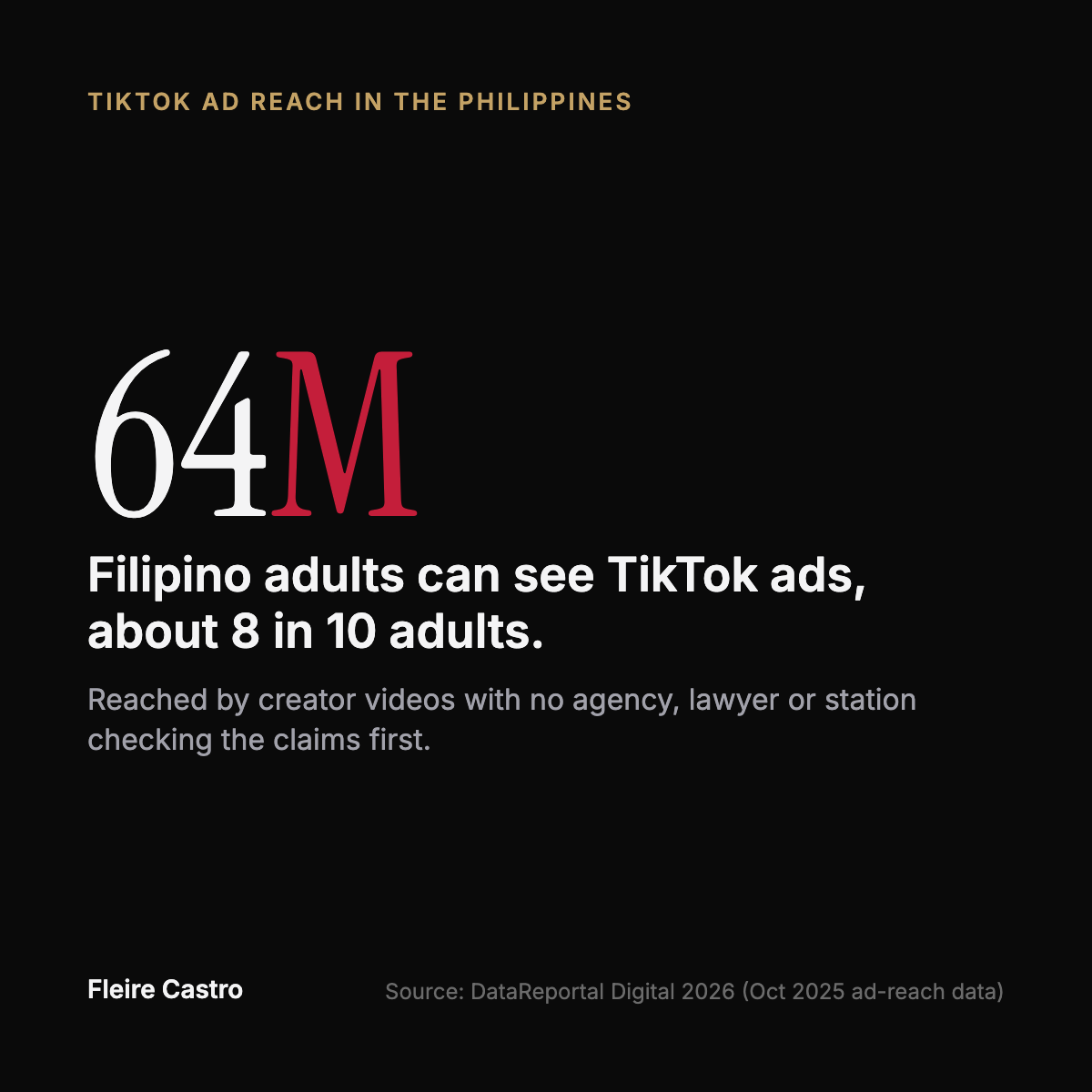
TikTok ads can reach 64 million Filipino adults, about 8 in 10 adults in the country, according to DataReportal's Digital 2026 report. Most of the ads that reach them are no longer made by an agency. A creator makes them at home, often the same day the brand ships the product.
I work with creators, so I'm not here to blame them. I'm here because the system that used to catch bad claims quietly disappeared, and most brands haven't noticed yet.
Cigarette ads show how the old system worked. Republic Act 9211 took cigarette ads off Philippine TV and radio in January 2007, and off all mass media in July 2008. The ban still holds. It worked for one boring reason: every channel had an owner. A station manager could look at an ad and refuse to run it. A billboard company could say no. The law only needed to reach the people who ran those channels to change what a whole country saw.
I call that layer the gatekeeper. A TV ad used to pass through at least three of them before it aired: the agency, the brand's lawyer and the station, while a creator post usually passes through none.
The rules themselves did not change. The Consumer Act still treats a false or misleading claim as the brand's responsibility. The FDA still expects every health or beauty claim to fit what the product is registered for. When a creator says a supplement "cures" something, the regulator and the customer both hold the brand to that word, not the creator.
What changed is the number of people deciding, and the speed. A brand that works with 50 creators now has 50 people writing ad copy, at midnight, without the three checks a TV ad used to get.
To find out whether your brand has the missing-gatekeeper problem, answer these four questions:
Who reads a creator's caption before it goes live? Name the person. If the answer is "the creator" or "we look at it after", there is no gatekeeper.
Does that person have a written list of claims your product is allowed to make? A brief that says "keep it fun" is not a list.
How fast can you pull a post that crossed the line? Hours matter when a screenshot can travel further than the post.
Who owns a comment thread that turns into a complaint? The creator, the agency or you?
At Dasho, my team built the checking step as software, because no human team can read every caption from every creator in time. The tool reads each creator post against the brand's own rules before the post goes live. Catching a bad claim in a draft costs nothing, while catching it in the comments can cost the brand its reputation.
Questions for management:
If a regulator asked for every creator post you paid for this quarter, could you produce them in a day?
Which of those posts made a claim your legal team never approved?
Who in your company is accountable for that gap today?
TV stations used to do this checking for brands, and now each brand has to do it for itself.
Fleire Castro is the founder of Dasho, which checks brand and creator content against each brand's rules before it goes live, and of Third Team Media.